
Key Takeaways
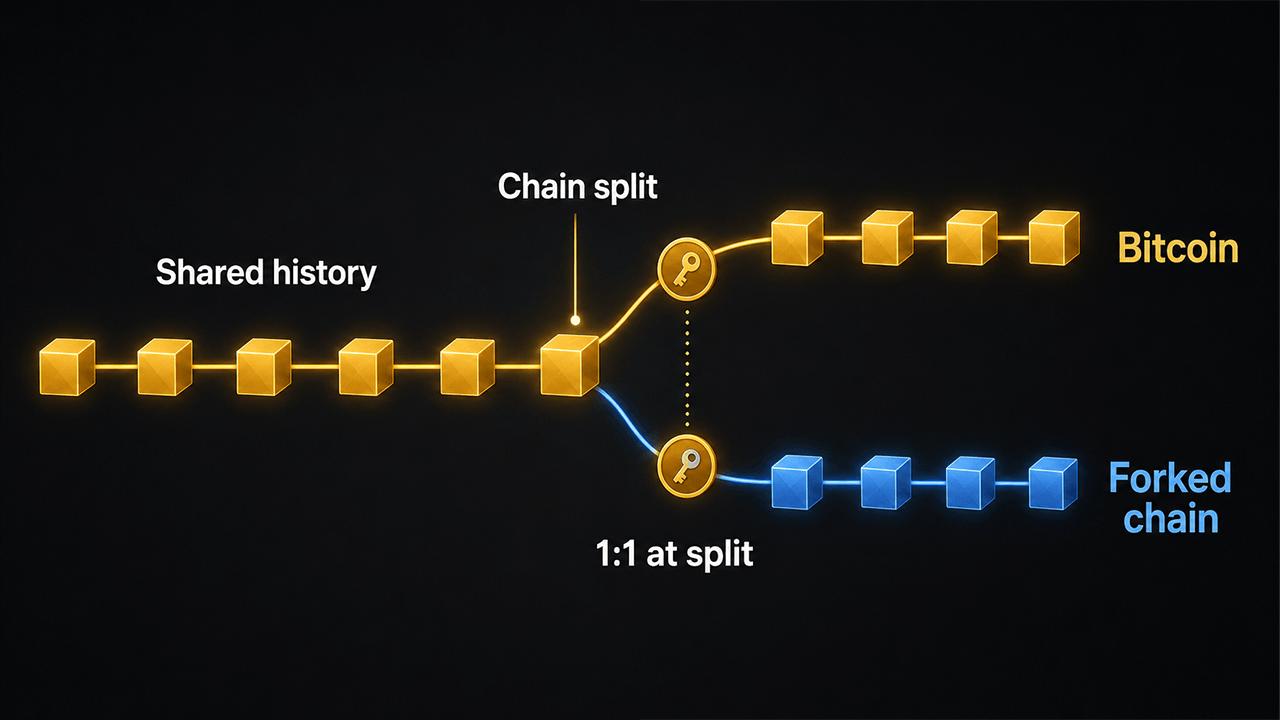
- A Bitcoin chain split duplicates the UTXO set, giving holders a 1:1 coin on both ledgers.
- Paul Sztorc’s eCash fork activates at Bitcoin block 964,000 around August 21, 2026.
- Replay protection, mining difficulty, and the market, not generosity, decide if a forked coin holds up.
The answer has nothing to do with generosity and everything to do with how Bitcoin actually keeps track of ownership.
Bitcoin Doesn’t Track Balances, It Tracks Outputs
Bitcoin has no account ledger with names and running totals. Instead, it tracks unspent transaction outputs, known as UTXOs. Each UTXO is a discrete chunk of bitcoin locked to a specific key. A wallet balance is just the sum of every UTXO that the private key can unlock. That detail matters because it explains what a fork actually copies.
When a hard fork produces a lasting split, two networks begin enforcing different rules starting from the same shared point in history. Every block before that point, and every UTXO that existed the moment before it, is identical on both chains.
Nothing needs to be recreated or reissued. Both networks already have the same records, because they were the same chain until the split.

Why 1:1 Isn’t a Gift, It’s Duplication
Picture a holder with 1 BTC in a single UTXO right before a split. That output exists in the shared history both chains inherit. The bitcoin chain recognizes it. The new forked chain recognizes it too, because it accepted the same blocks up to that point. The private key hasn’t been copied by some network process. It was already the only thing capable of spending that output, and now two separate sets of nodes independently agree on that fact.
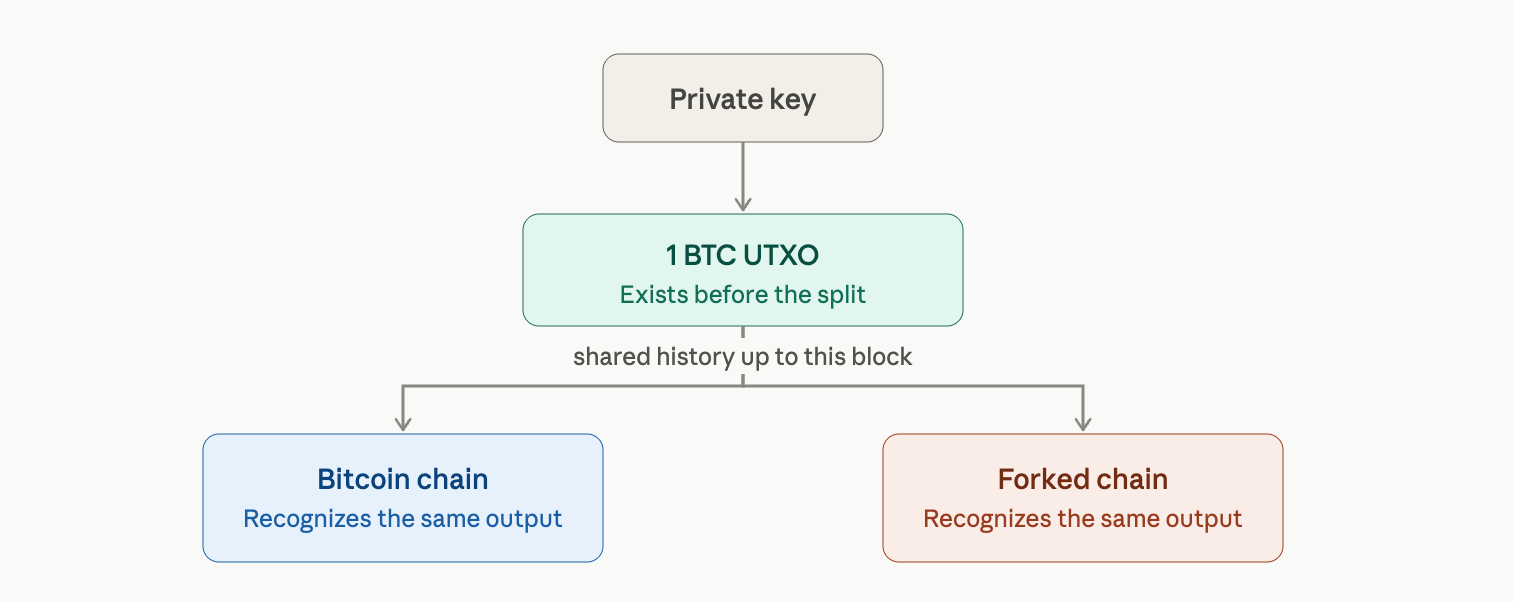
That’s why the ratio is always 1:1 at the snapshot. It isn’t an airdrop in the conventional sense, where a project mints new tokens and sends them to a list of addresses. Nobody compiles a list. No new transaction moves anything. The forked network simply calculates the same pre-split UTXO set that already existed, then starts applying its own rules to it going forward.
One Rule Doesn’t Guarantee Two Equal Futures
The 1:1 relationship only describes the instant of the split. After that, the two chains stop staying in sync. A holder can spend their bitcoin on the original chain while leaving the forked coin untouched, or the reverse. New bitcoin mined after the chain split exists only on the Bitcoin chain. New coins mined on the forked chain exist only there. Supply, price, and transaction history diverge from the split.
Self-custody makes claiming both sides straightforward in principle, since whoever controls the key at the snapshot can typically sign transactions on either chain. Custodial holdings work differently. If bitcoin sits in an exchange wallet, the exchange controls the key at the snapshot, not the individual customer. Whether that customer receives the forked coin depends entirely on the platform’s policy, not on the protocol itself.
Shared History Creates a Hidden Risk: Replay
Because both chains start with identical signing rules, a transaction built for one chain can sometimes be valid on the other too. Someone doesn’t need a private key to exploit this. They only need to copy an already signed transaction from one network and rebroadcast it on the second. If it goes through, a holder loses the ability to decide independently when and how to move their forked coin.
This is why serious forks in the past have built in replay protection, typically by embedding a chain-specific identifier into what gets signed. A transaction that includes that identifier validates on the intended chain and fails on the other, closing the loophole without requiring users to do anything extra. Forks without strong protection leave that decision to the holder, who may need to deliberately create a chain-exclusive transaction before it’s safe to move funds freely on either side.
Mining Difficulty Is the New Chain’s Next Hurdle
A forked chain also inherits Bitcoin’s mining difficulty, which was calibrated for whatever hashrate the network had before the split. That number rarely matches what the new chain actually attracts. If far less hashpower follows the fork, blocks arrive slowly until the next scheduled adjustment catches up, leaving the new network with a temporary window where it produces blocks unevenly and remains easier to disrupt than the chain it came from.
Hashpower Decides Which Chain a Node Actually Follows
One more detail keeps the two networks from bleeding into each other. Bitcoin nodes select the valid chain carrying the most accumulated proof of work (PoW), but only among chains that follow their own consensus rules. A node enforcing Bitcoin’s original rules won’t accept a forked block just because forked miners produced more cumulative work behind it. Hashrate settles disputes between valid competing blocks on the same ruleset. It has no power to make a node accept a block that violates the rules that node already enforces. That’s part of why a hard fork results in two persistent chains instead of one chain simply winning outright.
None of this changes the basic mechanism at the center of both eCash and BIP-110. A chain split doesn’t create value out of nothing. It duplicates recognition of an existing ownership record across two ledgers that then go their own way, leaving replay protection and mining stability to determine how usable the new asset becomes.